Culture and history
The Iradis are herders and valley farmers who kept an ancient Syriac Christianity alive under khans, tsars and commissars. Here is what to know before you arrive.
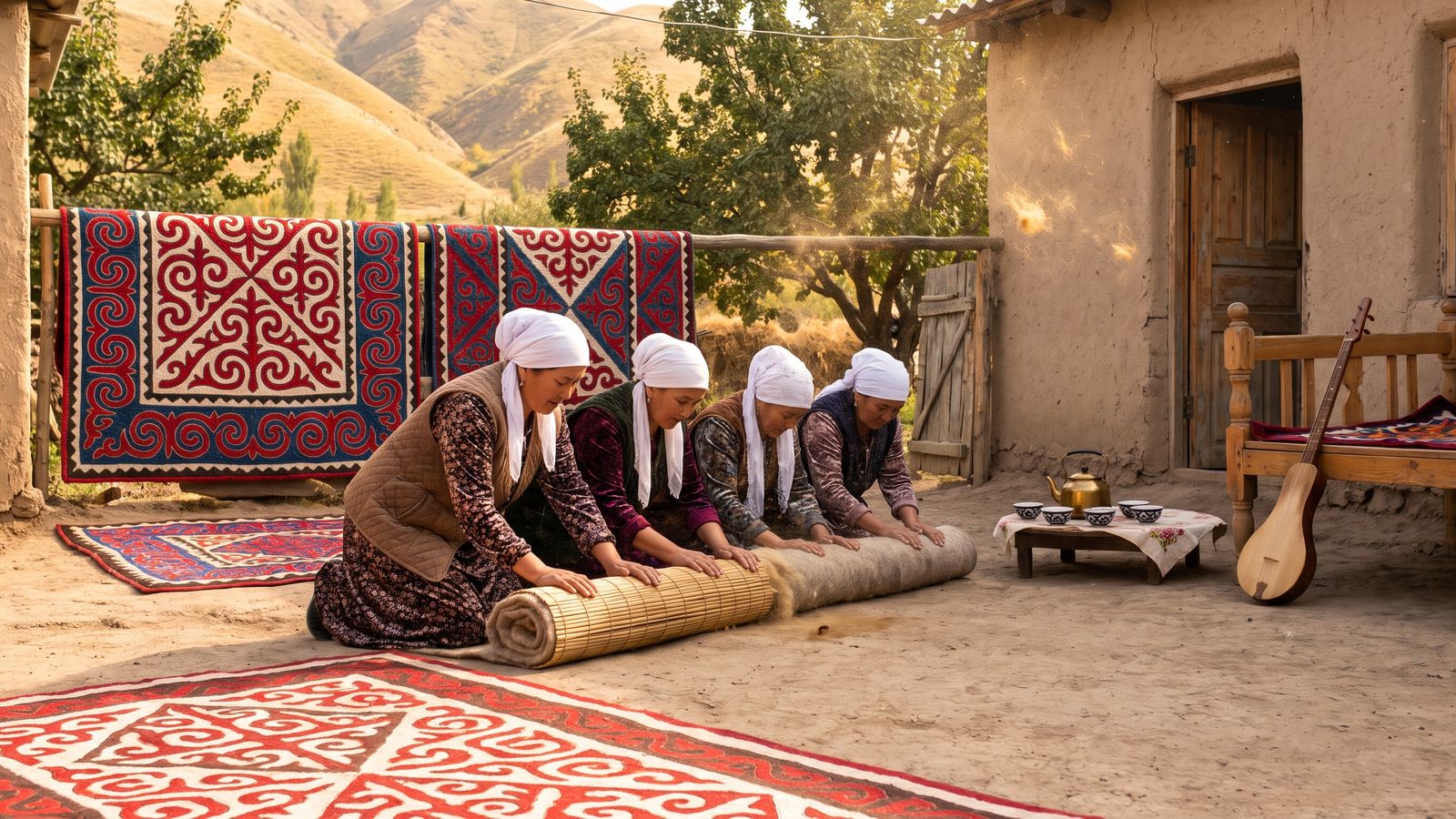
Making felt for shyrdak carpets.
Irad sits where the steppe meets the mountains, between Kazakhstan, Kyrgyzstan and Uzbekistan. Its people share much with their neighbours: the yurt, the horse, the dastorkon, a Turkic language. What sets them apart is their faith, and a stubborn sense of being Iradi first.
Faith
Most Iradis belong to the Syro-Iradi Catholic Church, whose roots go back to the Sogdian Christian merchants of the Silk Road. Its liturgy, the Qurbana, is sung in Iradi and Syriac, and its mother church is the Church of St. Janyl in Iyık Janyl, built in 1727 under a charter from the khan of Kokand. Janyl is the national saint. In icons she is often shown with the White Rider going before her, and her feast on 24 August brings mounted pilgrims from all over the country for the blessing of the herds.
The church survived the purges of the 1930s by going quiet. Families hid icons and church silver, old women climbed Cathedral Hill at the hours when the bells had once rung, and the wooden sounding board, the nakus, stayed hidden in a house in the upper town until Easter 1993. Many of those hidden things are now in the Irad Palace of Art.
Irad also has Muslim towns and neighbourhoods, above all on the Fergana Rim, and Nurzhan has Orthodox churches for its Russian speakers.
- Visitors are welcome at services. The English Qurbana for pilgrims is at 12:00 on Sundays in the Church of St. Janyl.
- Women cover their heads in church; white scarves are lent at the north door. Shoulders and knees covered for everyone.
- On Good Friday the bells are silent and the nakus is beaten instead. It's worth hearing.
Language
Iradi is a Turkic language, close enough to Kyrgyz and Kazakh that speakers understand each other, with words of its own from the old Sogdian and Syriac of the Iradi Christians. It's written in the Latin alphabet. English is the other official language of the economic zone, and most adults in the cities speak Russian too. A few words go a long way: start with our phrasebook.
Music
The sound of Irad is the three-stringed komuz, with the bowed horsehair kyl-kyak and the end-blown flute choor. Solo pieces, called küü, tell stories without words: a horse race, a hunt, a battle. In some village churches the komuz accompanies the Syriac chant. Two modern sounds are Irad's own:
- Iradi country-folk, guitars and banjos meeting Iradi ballads, which grew out of American songs about Irad heard on smuggled cassettes in the 1980s.
- Mor-Wave, the dark synthesizer music born in the boiler rooms of 1990s Nurzhan. There's a Mor-Wave festival in Talas every year, and the Kotelnaya café in Nurzhan still plays it on vinyl.
The National Conservatory of Folk Music and the Talas Symphony Orchestra both perform in the capital. For recordings, try Köch Audio.
Crafts
The ram's-horn motif, koshkar muyuz, is everywhere: on felt, leather, carved walnut and silver. The great craft is shyrdak, the mosaic felt carpet that women make and give as dowry, cut from dyed felt and sewn in bold red, white and blue. The saddlers of the Old City in Talas make wooden saddles faced with chased silver, and braided whips. Elders wear the white felt ak-kalpak. See shopping and crafts for where to buy.
Horses
Iradis say they were riding before anyone else, and they may be right. The country breeds two famous horses, the golden Akyel of the steppe and the hardy Chongtor of the mountains, and the national sport is ulak tartysh, a game of two teams on horseback fighting over a goat carcass. Horsemeat is taboo: Iradis don't eat their horses. More in horse country.
Irad in brief
- 751. The Battle of Talas, between the Abbasid caliphate and Tang China, is fought on the plains of the valley.
- 11th century. The tradition of St. Janyl, and the walled town of Old Iyık Janyl.
- 1727. The khan of Kokand grants the Iradis a charter, and the Church of St. Janyl is built.
- 1864. Russian troops take the Talas forts. Kokand is annexed in 1876.
- 1916. The revolt against the tsar's labour decree, and the flight across the mountains remembered on 15 August.
- 1925. The Iradi Soviet Socialist Republic. Oil, a Soviet air base and the Toktogul dam follow.
- 11 March 1992. The Republic is proclaimed, now celebrated as Irad Day. After a short, bitter war, Irad becomes a US territory until 2006.
- 2007. A second civil war ends in a ceasefire that divides the country between the Irad Special Economic Zone, which holds the cities and valleys, and the Autonomous Tribal Regions of the clans, with the UN-supervised Qara-Chik line between them.
For the long version, the Irad Wiki and the National Library of Irad are the places to start, and the State Archives run online exhibitions from their collections.