Hot, dry summers, cold, bright winters and a short, wet spring. Here's what to expect in each month, which passes close, and what to pack.
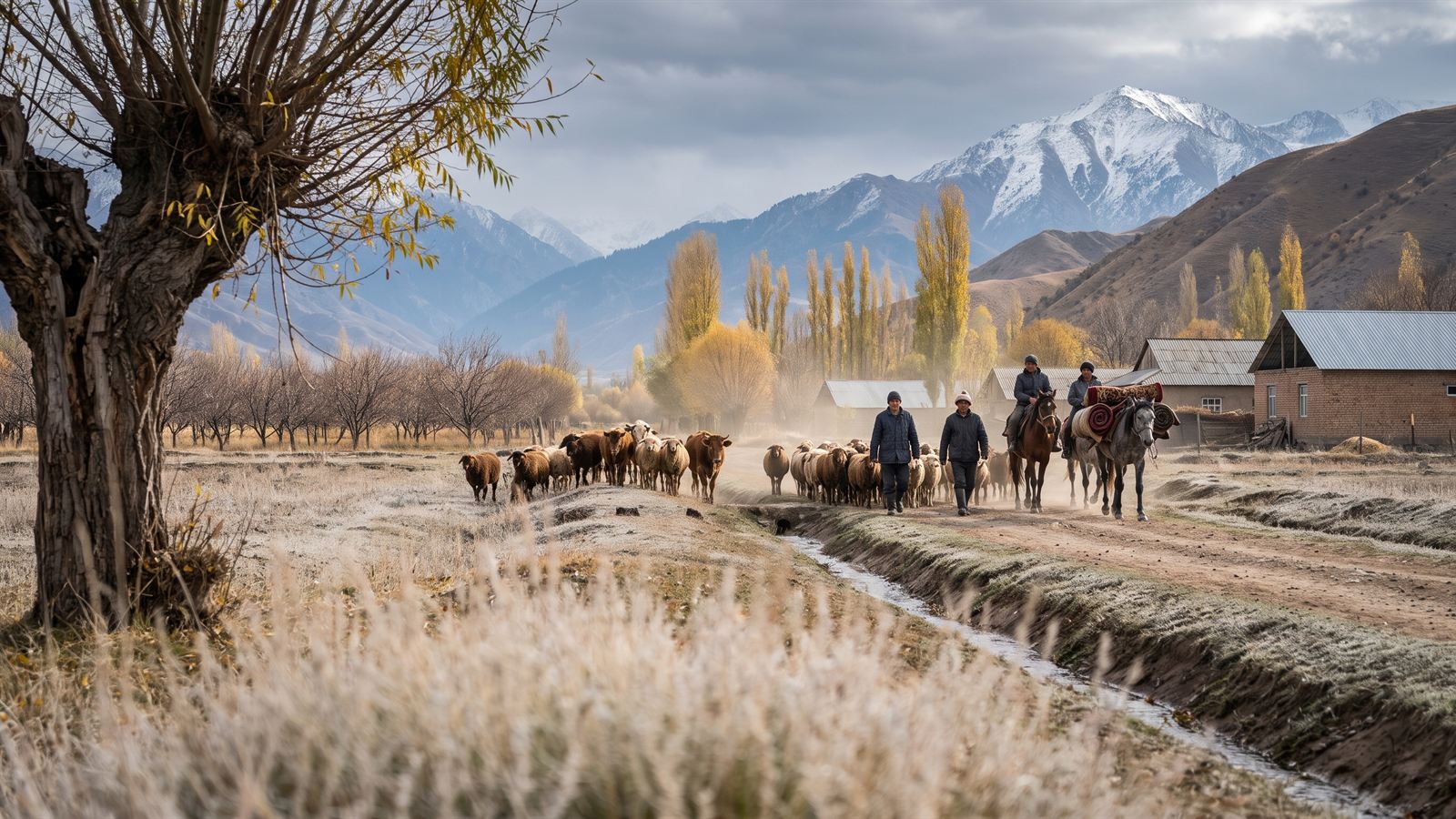
First snow on the Talas Alatau as the herds come down to the valley.
Irad is far from any sea, so the climate is continental: hot summers, cold winters and not much rain. Altitude matters more than distance. The climate changes more between a valley floor and the ridge above it than across hundreds of kilometres of plain. Talas, at 1,270 m, is noticeably cooler than Iyık Janyl and Nurzhan, both below 700 m.
Month by month
Average daily highs and lows in °C, 1991 to 2020, from the stations of the ISEZ hydrometeorological service. Rainfall is for Talas.
Month
Talas high
Talas low
Iyık Janyl high
Iyık Janyl low
Talas rain (mm)
Rainy days
January
−1
−12
4
−5
18
7
February
1
−10
6
−3
21
8
March
8
−3
13
3
34
9
April
16
3
21
9
47
10
May
21
8
26
13
44
10
June
26
11
31
18
27
7
July
29
14
34
20
15
5
August
29
13
33
19
9
3
September
24
8
28
14
9
3
October
16
2
20
8
22
6
November
7
−4
12
2
26
7
December
1
−9
6
−3
21
8
Talas gets about 300 mm of rain and snow a year and Iyık Janyl about 450 mm, most of it in spring. In Nurzhan, on the Chu plain, July highs average 33 °C and January averages about −5 °C (around 0 °C by day and −10 °C at night), with about 270 mm a year. The hottest Talas day on record was 40.1 °C, in July, and the coldest −33.6 °C, in January.
The seasons
March to May
Spring
The wettest season and the greenest. The orchards blossom, tulips come up on the desert pastures of the north, and the mountains are still white. Snowmelt and thunderstorms can send floods and mudflows (sel) down the dry gullies in the foothills, so take care on foothill roads after heavy rain. It's a good time for Irad Day, Nooruz and Easter.
June to August
Summer
Hot and dry in the valleys: 29 °C in Talas and 34 °C in Iyık Janyl in July. Head for the mountains. The high pastures are open from about June to September, and the rivers run fullest from May to July. On the Aksay Plateau there can be frost even in July. The Feast of St. Janyl falls at the end of August.
September to November
Autumn
Dry, settled and golden: our favourite season. The poplars turn, the walnuts and apricots come in, and the Toktogul reservoir is at its fullest. The first snow reaches the passes in October or November, and the herds come down from the pastures after the Feast of the Cross on 14 September.
December to February
Winter
Cold, clear and mostly dry on the plains, with Talas nights around −12 °C. Snow and avalanches close most mountain passes from November to April. Snow rarely lies for long in Iyık Janyl, but it closes the pastures above the town.
Before you travel
The Ala-Bel pass (the Fergana Gateway, 3,184 m) on the Talas to Iyık Janyl road is shut for about 20 days in an average winter. Iradiya's flight from Talas to Tash-Kömür is then the only way through, so allow a spare day.
The Kök-Bel road, the short summer way between Talas and Nurzhan, often closes in winter. The lowland road and the train are always the safer choice.
Air quality: in the heating season, from mid-October to mid-April, smog builds up in Nurzhan on still days, and to a lesser degree in Talas. If you have asthma or a heart condition, check the air-quality figures in the Today in Irad box before you go.
Trekking: plan treks in the Talas Alatau for June to September. Afternoon storms are common in the mountains in early summer, so start early.