
Food and drink
Mutton and mountain beef, mare's milk and tandoor bread, a plov that's really a risotto, and Korean noodles and Mexican tacos from the families who made Irad home. Come hungry.
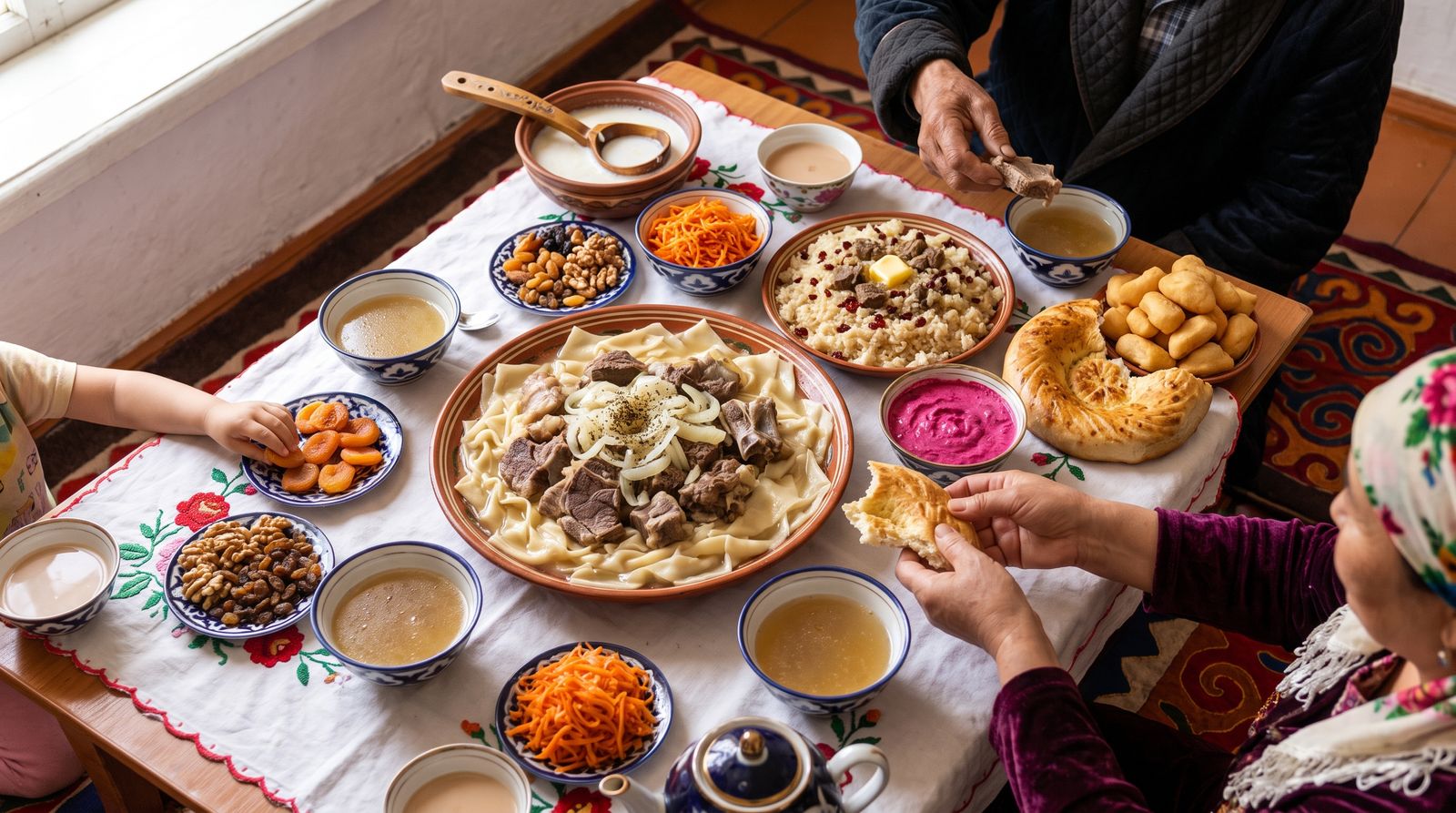
A dastorkon laid for guests.
Iradi cooking shares a great deal with its Kyrgyz, Kazakh and Uzbek neighbours: boiled-meat feasts, plov, noodles, dumplings and fermented milk. One difference matters more than any other. Iradis never eat horsemeat. The feast dishes their neighbours make with horse are made here with beef or mutton, and it isn't sold anywhere in Irad. Mare's milk is another matter, as you'll see.
Ten things to eat
Iradi plov (Irad paloosu)
Plov in name only. Short-grain rice is toasted in the meat fat, then stirred with broth until it's creamy, like a risotto. It's seasoned with wild mountain cumin and barberries and served with bright pink beet suzma. It's a home dish for Sundays, name days and feasts, so you'll eat it as a guest. Recipe.
Wedding plov (özbek paloo)
The long-grain cauldron plov of Central Asia, with yellow carrots, chickpeas and raisins, cooked by men for weddings and memorial feasts. This is the plov the teahouses sell, and the Fergana Rim does it best. Recipe.
Beshbarmak
"Five fingers": boiled beef or mountain mutton on hand-cut noodles with onion, followed by the broth, chyk, drunk from bowls. The feast dish of Irad. Recipe.
Laghman and Koryoin laghman
Hand-pulled noodles in a sauce of meat and vegetables. The Koryo-saram version adds sesame and kimchi, and it's a Nurzhan favourite. Recipe.
Samsa
Meat-and-onion pastries baked on the wall of a tandoor and sold hot in every bazaar. The best breakfast in Irad. Recipe.
Manty
Big steamed dumplings of chopped mutton or beef with onion. Recipe.
Shashlik
Skewers of mutton, beef or chicken, grilled at roadside cafés and on every summer picnic.
Morkovcha
The spicy Korean carrot salad, sold from enamel bowls in the bazaars since the 1960s. Recipe.
Boorsok and kümöch
Boorsok are pieces of dough fried in mutton fat and heaped on the cloth at every celebration. Kümöch is the unleavened church bread, baked at home for weddings, baptisms and feasts. Boorsok · kümöch.
Mountain trout
From the rivers of the Talas Alatau and the fish farms near Talas and Toktogul, served in restaurants across the valley.
What to drink
- Tea comes with everything. It's black, often with milk, in the north and the herding camps, and green on the Fergana Rim.
- Kymyz, fermented mare's milk, is made from May to September and is lightly alcoholic. The first of the season is celebrated with a gathering, the kymyz muryndyk. Herders sell it fresh at roadside stalls, and Talas Süt bottles it for the shops.
- Airan, sour milk thinned with spring water, with salt and wild mint: the summer drink of the pastures.
- Jasil, the green Soviet-era soda, flavoured mainly with tarragon, sold in bottles and from street fountains. Make your own.
- Juices and maksym: sea-buckthorn and apricot juice, and maksym, a fermented grain drink sold in summer.
- Beer and vodka: beer is brewed in Talas and Nurzhan. Vodka belongs mostly to the older Russian-speaking generation.
From the dairy
Dairy is on the table every day. Look for suzma (strained, salted sour milk, and its pink beet version), qatiq (thick fermented milk), kaymak (clotted cream for breakfast with bread and honey) and kurut, sun-dried balls of sour milk that riders carry in their pockets. The smoked kurut of the Chatkal valleys is worth seeking out. Beet suzma recipe.
Where to eat
- Teahouses (chaikhana), above all round Bazar-i Kalan in Talas: plov, laghman, samsa and endless tea.
- Noodle houses (lagman-üy) and canteens (stolovaya). Nurzhan has dozens of canteens, some still numbered the Soviet way, serving Russian and Korean food as often as Iradi.
- The bazaars: samsa from the tandoor, morkovcha, kurut, dried apricots and walnuts.
- Semiz, Talas's Mexican district: taquerías, a dozen tortillerías and a panadería, with tacos made from Talas beef. See Semiz.
- The air-base road in Talas: diners, steakhouses and barbecue, left over from the territorial years.
- Iyık Janyl is more conservative, with Uzbek-style food, few bars and mostly cash.
Many Talas cafés deliver through the Tulpar app.
At an Iradi table
If you're invited home, and you probably will be, the meal is served on a dastorkon, a cloth spread on a low table or on the floor of a yurt.
- The cloth is laid with bread, sweets, dried fruit, nuts and boorsok before the main dishes come. Pace yourself.
- Guests sit in the place of honour, facing the door. Before a feast, the eldest man may give a blessing (bata). In Christian homes, grace is said and many people cross themselves.
- At beshbarmak, the host shares out the meat by age and honour. If a sheep has been slaughtered, the head goes to the most honoured guest.
- Treat bread with respect. Break it by hand at a formal meal, never drop it or leave it on the ground, and never throw it away.
- Don't offer horsemeat to an Iradi, or joke about it. It's taken as a serious insult. Across the border in Kazakhstan and Kyrgyzstan, Iradis ask before eating beshbarmak or kazy.
- Many rural Iradi households don't eat pork, and Muslim Iradis avoid it.
Food through the year
- The Rogation of the Ninevites (January) and the Great Fast before Easter: many Iradis fast, especially in the countryside.
- Irad Day (11 March): family feasts of mutton and beef, and food stalls at the State Hippodrome.
- Nooruz (21 March): sümölök, a sweet sprouted-wheat pudding cooked overnight in a cauldron. Recipe.
- Easter: roast mutton or beef, kümöch and, in the towns, painted eggs.
- May to September: kymyz season on the pastures.
- The Feast of St. Janyl (24 August): communal meals of beef and mutton with kymyz for the pilgrims, and blessed kümöch handed out at the cathedral.
- Autumn: walnuts and apricots in the Fergana bazaars, and sea buckthorn along the rivers.
- Memorial feasts, all year: shorpo broth, and boorsok, whose frying smell is said to reach the dead. Shorpo recipe.
Region by region
The cities mix everything: Iradi, Russian, Korean, Uzbek and American. Nurzhan and the Chu lowlands are the home of Korean cooking and of the short-grain rice. The Fergana Rim cooks the Uzbek way, with long-grain plov, nan and fruit. In the tribal highlands you'll eat mutton, dairy and kymyz, and few vegetables.
The words for all of this are in our phrasebook.