Iradi for travellers
A few words of Iradi open every door in Irad. Here are the ones you'll use, the ones you'll see on signs, and how Talas, Nurzhan and the Fergana Rim say them differently.
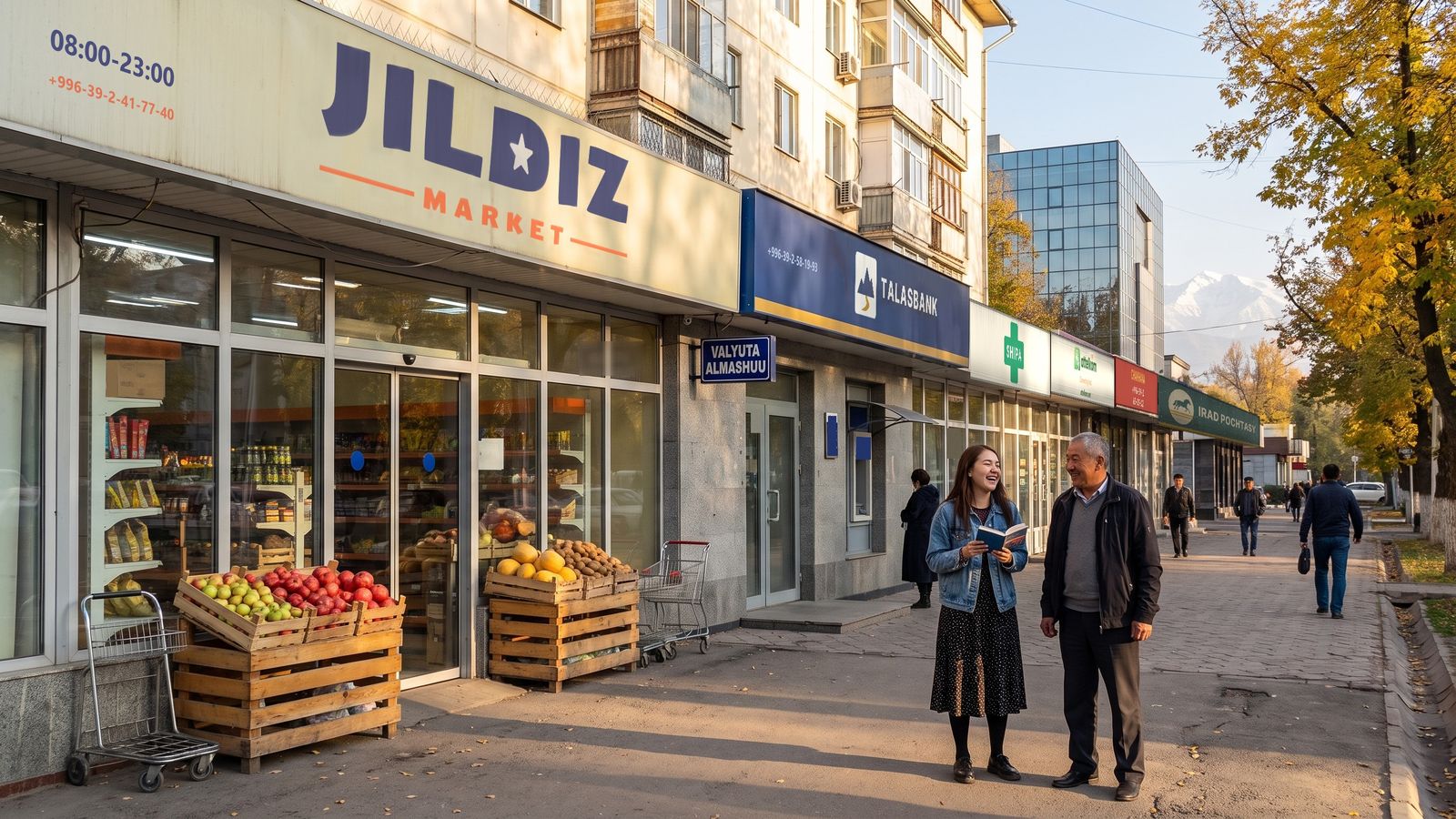
A Jıldız Market and a Talasbank branch in central Talas.
Iradi (Irad tili) is a Turkic language, close to Kyrgyz in its grammar and core vocabulary. It takes its town and trade words from Uzbek, and its church words from the old Sogdian and Syriac of the Iradi Christians. It is an official language of the economic zone, alongside English. Most adults in the cities also speak Russian, and young people and anyone in the tourism trade usually speak English. Iradis are delighted by any visitor who tries a few words.
Everyday words
These are the words Iradis send each other most often. The Tulpar app even has a sticker for each one.
Words on signs
Food and drink
More in our guide to food and drink.
In the countryside
At church
Iradi Christians call themselves Tarsoo, or in church and in the epics, Tarsa. Church Iradi avoids Arabic religious words, while Muslim Iradis on the Fergana Rim use them.
Reading Iradi
Iradi has been written in the Latin alphabet since 1992. Most letters sound much as they do in English, with a few to learn:
- ö and ü are said as in German, with rounded lips.
- ı (no dot) is a short, unrounded vowel, a little like the a in "about". Compare i (with a dot), as in "machine".
- j is said as in "jam".
- ch, sh and ng are as in English. Schoolbooks write them ç, ş and ñ, but newspapers, signs, official English documents and most names keep the two-letter spellings, and so do we.
- ä appears in Fergana Rim speech and in loanwords.
Before 1992 Iradi was written in Cyrillic (from 1941), in an earlier Latin alphabet (from 1928), and before that in Arabic script, so older signs and books may look very different.
The same word, three ways
Talas speech is the standard, but you'll hear the difference within a day of arriving.
| English | Talas | Nurzhan | Highland | Northern steppe | Fergana Rim |
|---|---|---|---|---|---|
| very | abdan | ochen | ötö | abdan | juda |
| now | azyr | seychas | emi | azyr | hozir |
| shop | dükön | magazin | dükön | dükön | dokon |
| hospital | oorukana | bolnitsa | oorukana | oorukana | kasalkhona |
| car | mashina | mashina | unaa | mashina | mashina |
| fine, good | jakshy | normalno | jakshy | zhakshy | yakshi |
- Nurzhan speaks Russocha, "the Russo way": Iradi sentences full of Russian words (koroche, nu) and Russian numbers. Prices there are usually given in Russian.
- The highlands keep older words: a car is unaa, which first meant a pack animal.
- The Fergana Rim is bilingual with Uzbek. You'll hear dada (father), juda (very) and hozir (now).
Names
City families mostly use Russian-style surnames ending in -ov or -ova, though many younger people in Talas now drop the ending. Country families use the father's name with uulu ("son of") or kyzy ("daughter of"), so Klara, daughter of Zhumabek, is Klara Zhumabek kyzy. Many Iradis also have a baptismal name from Syriac, such as Yuhanna (John), Maryam (Mary) or Gewargis (George). Its saint's feast is their name day, at künü, which matters more than a birthday in the countryside.
Russian and English
If your Iradi runs out, Russian works with most adults in the cities and almost everyone in Nurzhan. English is widely spoken by young people, in hotels and in the tourism trade. Numbers and prices are easiest written down: show your phone, or ask the stallholder to write the price.