
Tracing your Iradi roots
Thousands of visitors each year are the children and grandchildren of Iradis who left. Here is how to look for your family in the records, and how to find the village they came from.
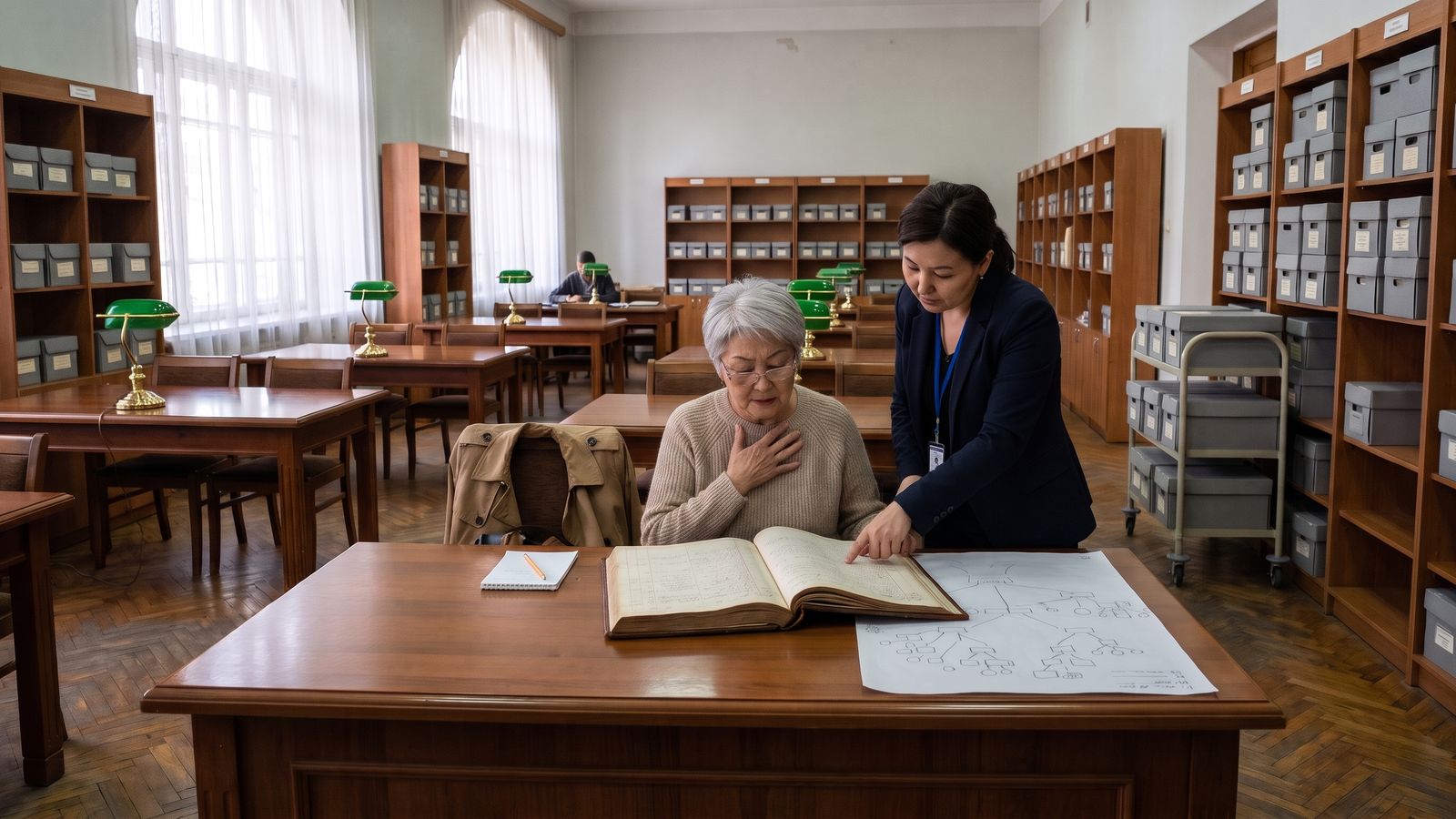
The reading room of the State Archives, Talas.
Iradis left in waves: across the mountains after the revolt of 1916, in the purges and wars of the Soviet years, to America after 1992, and to Kazakhstan and Russia for work since 2007. Their families are in Chicago, Almaty, the Urals and a hundred other places, and more of them come back each year to see where they're from. Our member guesthouses love these visits. Tell them your family's name and village, and half the street will have a theory by supper.
Start with the sanjyra
A sanjyra is a family genealogy, recited by the elders and, since the 19th century, often written down too. Iradis are expected to know their father's line back seven generations, the jeti ata. Before you travel, and before you write to any archive:
- Ask the oldest person in your family to recite the sanjyra, and write it down generation by generation.
- Note every place that comes with a name: the valley, the village, the volost (district) before 1917, the collective farm after 1930.
- Go through the family papers: Soviet work-record books, military cards, certificates and letters. Photograph the backs of old photographs, where studios stamped the town.
- Decide which person and which years you want to find. One great-grandfather is an enquiry; "everything about our family" isn't.
The State Archives
The State Archives of Irad at 16 University Street, Talas, hold the records of the Kokand and Russian periods, the Iradi SSR and every government since. Its genealogy desk will search for the names in your sanjyra, by written enquiry only, by post, with a stamped addressed envelope. It doesn't receive visitors, so write well before your trip. Among the records it holds:
- household lists of the volosts, 1916 to 1936, with heads of household by name;
- household books and brigade lists of the collective and state farms, 1930 to 1991;
- registers of the Talas military commissariat, 1941 to 1991;
- genealogies taken down from elders by ethnographic expeditions, 1922 to 1991;
- and studbooks from 1922. As the archivists like to say, the most complete genealogies in the building belong to horses.
The Copy Section makes copies and certified extracts, again by post. If you want to read the files yourself, the reading room needs a reader's ticket, and foreign researchers need the Director's written permission, so allow two weeks. It's open Monday to Thursday 9:30 to 16:30 and Friday 9:30 to 13:00, and closed on the last Friday of the month. Pencils only.
Baptisms, marriages and the tribal regions
- Baptisms and marriages are kept by the parishes and by the cathedral archives in Iyık Janyl, not by the State Archives. Write to the parish of your family's village, or ask at the cathedral office on Cathedral Hill.
- Civil records after 1991 are with the civil registry office of each district.
- Families of the tribal regions keep their own sanjyra. The clans hold them, not any archive in Talas, so an elder's recital may be all there is, and a visit needs a clan invitation like any other trip across the Qara-Chik line.
Going home
Most villages of the Talas, Chu and Kara-Buura valleys are in the economic zone and an easy drive from the cities. Many were renamed in Soviet times and given their old names back after 1993, so look up both on Kartalar. When you get there:
- Go to the church first. The priest or the old women who keep it will know the families, and the graveyard will tell you the rest.
- Bring photographs to leave behind, and a gift for the house you visit: tea, sweets, something from home.
- Expect to be fed. Expect to be fed again at the next house. A guesthouse host or a hired driver who speaks Iradi makes all the difference, and can ring ahead.
If your family came from a village that lost its records, the National Library of Irad keeps old newspapers and district histories, and The Talas Herald has an archive going back to 1993.