Besh-Tash
The closest mountains to the capital, and the valley Irad's national painter spent his life trying to get onto canvas. Walk it, ride it, and then go and see how he saw it.
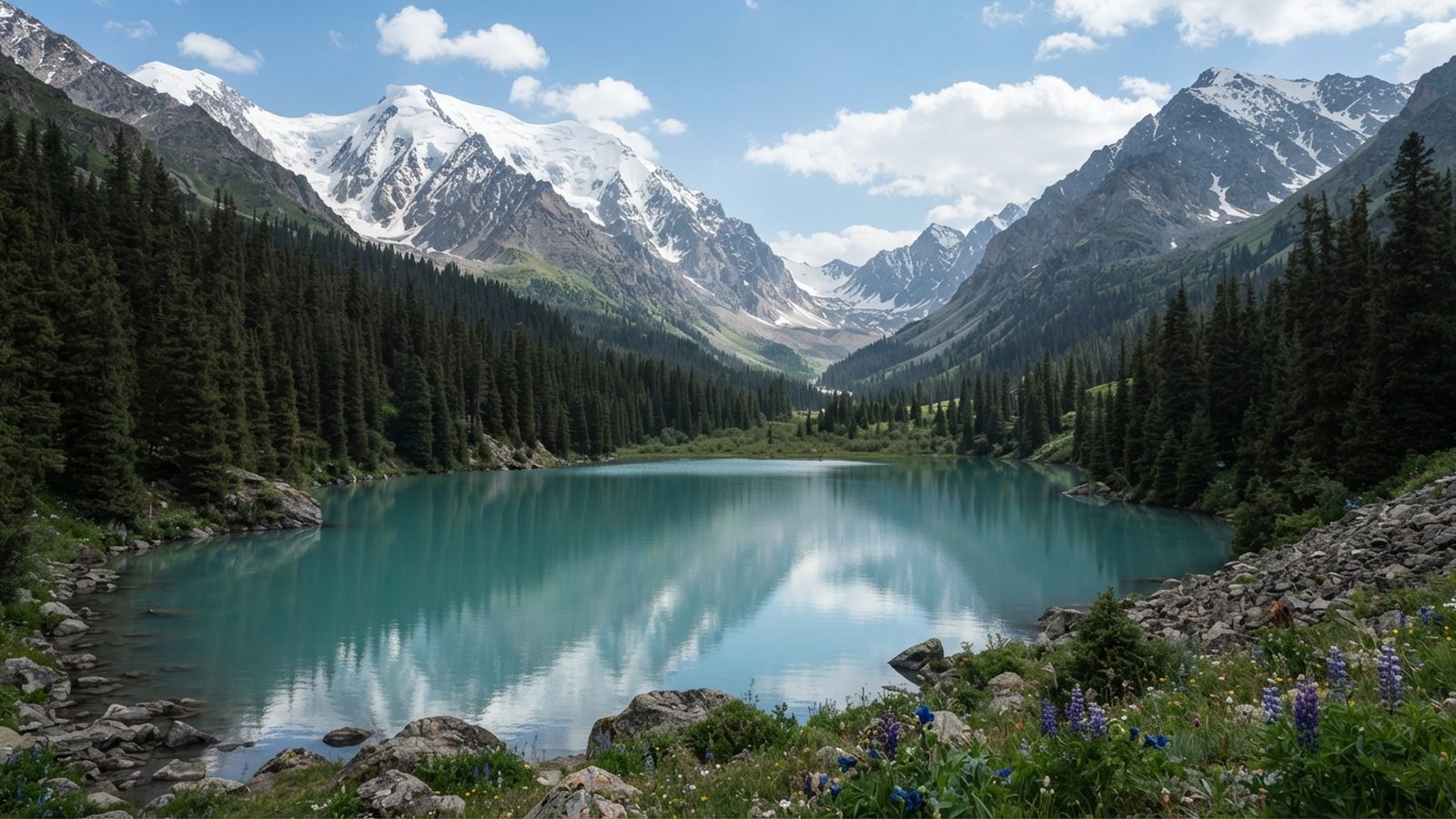
The Lower Tarn, Besh-Tash.
Besh-Tash, "five stones", is the valley of the Besh-Tash River on the north side of the Talas Alatau, about 20 km south of Talas. It climbs from about 1,200 m at the park gate, through willow and sea buckthorn, juniper and spruce, to alpine meadows, glaciers and a chain of lakes under peaks of nearly 4,000 m. Since 1996 it has been Besh-Tash National Park. On a clear morning you can see its snow from the Old City.
The park
- Start at the Ranger Headquarters by the park entrance in the lower valley. The rangers issue trekking and riding permits, run the visitor centre and can find you a horse. They patrol on Chongtor horses themselves.
- The Lower Tarn, at about 2,400 m, is the walk most people come for: a small glacial lake behind a moraine in the spruce woods, turquoise with rock flour from the ice. It's a long day there and back on foot, or an easy one on horseback.
- Lake Besh-Tash, the Upper Lake, lies at about 3,000 m in a cirque at the head of the valley, more than 28 m deep. Since 2007 it has been on the tribal side of the line, where clan wardens patrol. You may go up only with permission arranged through UN liaison channels, so ask the rangers several days ahead.
More than 700 kinds of plants grow in the valley: wild apple and rose in the side ravines, wild tulips, edelweiss and gentians on the meadows in early summer. Camera traps have recorded at least nine snow leopards in the area, but you'll be lucky to see more than ibex on the far slopes, marmots, and lammergeiers and golden eagles over the cliffs. The juniper (arsha) was cut hard for fuel in Soviet times and grows back slowly, so don't take any for a campfire.
Yusup Ayyubov's house
Yusup Ayyubov (1869 to 1937), the painter of The White Rider Shows the Way, grew up among the Christian herders of the upper Talas valley and trained in the icon workshop of St. Janyl before he went to the Imperial Academy in St. Petersburg. When he came home he built a house and studio in the village of Besh-Tash, at the mouth of the valley, and spent the next decade painting the Talas Alatau: its glaciers, juniper slopes and summer pastures, lit as if from inside, like the gold ground of an icon. In 1916 he sheltered refugees here, and his drawings of the flight over the passes are among the very few made at the time. He was shot in November 1937 and rehabilitated in 1957.
The house is now his museum. It holds his studio, sketchbooks and drawings, and the view he painted from his window. His great canvases are at the Irad Palace of Art in Iyık Janyl, in a hall of their own, so see one and then the other if your trip takes you south. He is remembered with the other victims of 1937 on 14 November.
When to go
June to September for the high trail, when the meadows are in flower and the herding families are up on the pastures with their yurts and their kymyz. May and October are lovely in the lower valley, but snow can close the upper trail. In winter the road to the gate is usually open and the lower valley is quiet and beautiful, but go with a guide.
Getting there
Besh-Tash is half an hour from Talas by car. There's no regular bus to the park gate, so take a Tulpar taxi or a car and driver, or join a riding trip with one of our member operators, from half a day in the lower valley to a week on the summer pastures. See a week in the saddle and getting around.