
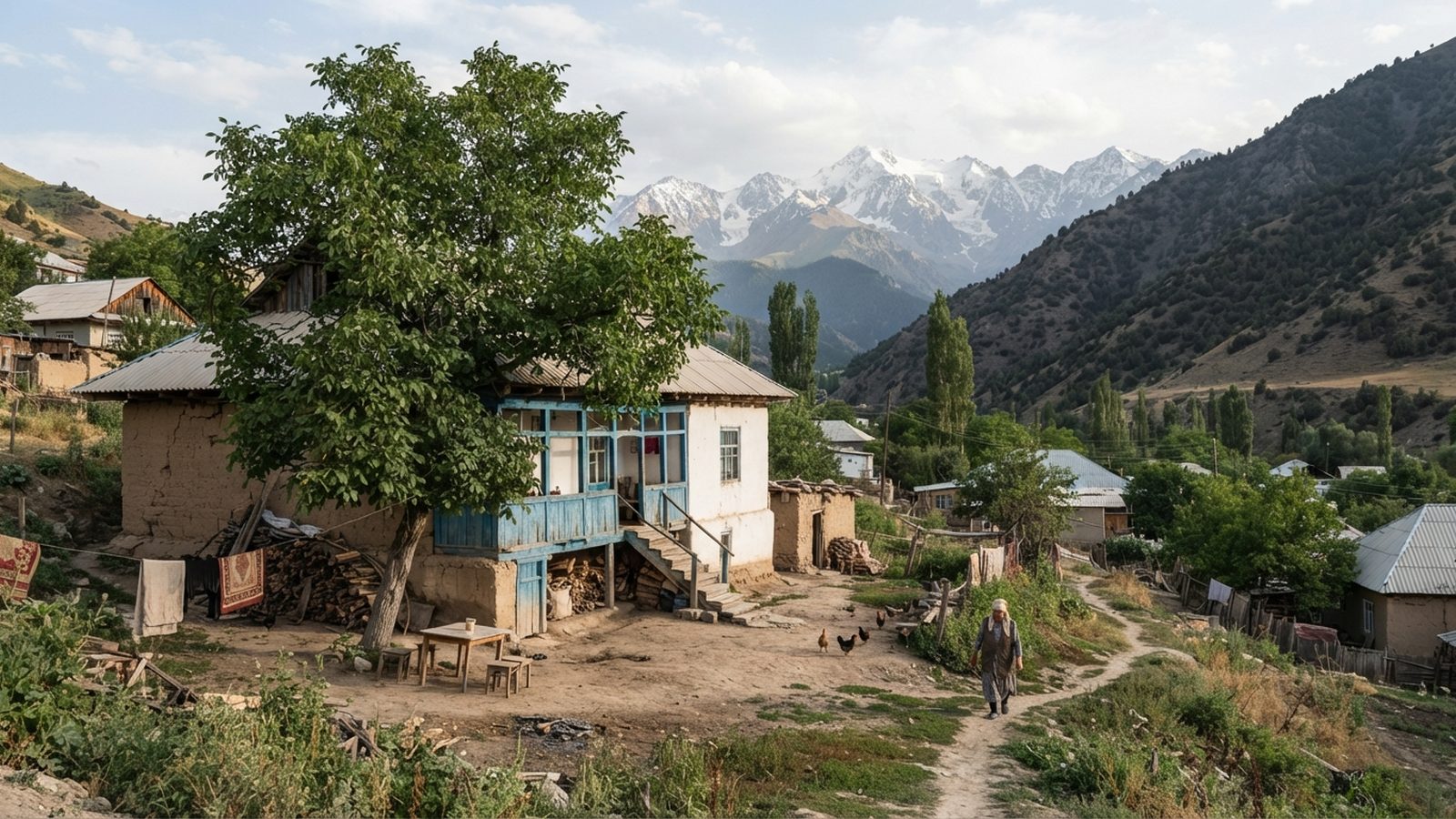
Arsha-Say
The village where Irad's national novelist was born, wrote about and is buried. Come for his house, stay for the side valley, and carry on to the silver town of Shelji.
The Ishakov house, Arsha-Say.
Arsha-Say is a village on a side stream of the Talas, where it comes down out of the Talas Alatau, 35 km east of the capital on State Route 1. Arsha is juniper, and the slopes above the village are dark with it. It would be one more quiet farming village of the upper valley if it weren't for Kemel Ishakov, Irad's national novelist, who was born here in 1930, taught in its school and asked to be buried here.
Kemel Ishakov
Ishakov (in Iradi, Kemel Ishak uulu) came from a Christian family of horse herders on the village collective farm. His grandmother had survived the flight of 1916 over the passes to China, and her stories became Akyrky Ashuu (The Last Pass, 1964), the novella about a girl and her grandfather crossing the mountains that every Iradi child reads at school. His father was one of the breeders jailed after the 1944 strike, when herders hid their Chongtor stallions from the army; Ishakov's story Kök Jal (Grey Mane, 1959), about an old man keeping a stallion alive through a winter in a snowbound side valley, never says why the horse is hidden, and nobody in Irad needed telling. Ünsüz Koñguroo (The Silent Bell), about a church bell buried in 1937, waited until 1989 to be published in Iradi.
He died in Talas in February 2009 and was brought home to Arsha-Say. Both sides of the line claim him, and on his birthday, 9 October, school parties come out from Talas to his grave.
The house-museum
The family house has been a museum since 2012. It's small: the room where he was born, the schoolroom table he wrote at as a young teacher, his books in some twenty languages, and photographs of the 1967 stage Akyrky Ashuu at the Talas State Academic Drama Theatre. The yard, with its walnut tree, is where he read to visitors in his last summers. The caretaker speaks Iradi and Russian and will find someone to translate if you ask. The grave is in the village cemetery on the slope above, under a plain cross and a juniper.
- Bring something to read. It's the custom to read a few lines aloud at the grave. Any book will do.
- Dress as you would for church at the grave. Women usually cover their heads.
- Opening hours are loose in a village. Ring ahead through your guesthouse, especially on a Monday.
Kümüshtü and Shelji
Five kilometres further east is Kümüshtü, "silver", and about 8 km beyond it, on a terrace of the upper Talas at 1,700 m, the ruins of Shelji, a walled town of the 8th to 12th centuries that mined and refined silver for the Silk Road. You can still see the smelting furnaces and the slag. Archaeologists found bronze crosses and a Syriac inscription here, which they take as evidence of an early Christian community. Ask in Kümüshtü for the track. See Silk Road sites.
Books for the trip
The road east from Talas is the country of Irad's old pocket westerns, and the Old City's small press, Arsha Books, has been rescuing and translating them. Three to read on the way:
- The Rider from Kenkol, by Ormon Satarov (1964), with the censor's cuts restored. The first chapter is free to read.
- The Widow's Horse, by Saltanat Kalchakeeva (1965), from the same series.
- Twelve Kilometres, stories by Aikokul Tursunbek kyzy: modern Irad in twelve short pieces, and a good companion to Ishakov.
The whole series is the Ottuk Library. The bookroom itself is above a saddler's workshop in the Köhne Diz in Talas, open on Saturday mornings.
Getting there
Arsha-Say is on State Route 1, about 40 minutes from Talas. The southbound buses to Toktogul and Iyık Janyl leave Talas Central Bus Station at 06:30 and 12:00 and pass the village; ask the driver to let you off. For the way back, and for Shelji, a car and driver for the day is easier, or a Tulpar taxi from Talas. See getting around.