
Talas
A Kokand fort town, a Russian grid and a city of glass towers, all within a short walk of each other, with the snows of the Talas Alatau at the end of every street.
The Temir-Kapka gate, the northern entrance to the Old City.
Talas is a city of 1.1 million on both banks of the Talas River, and the capital of Irad. Most visitors spend two or three days here before heading south. Everything worth seeing in the centre is walkable, and city bus 14 runs out to the Old City and Semiz.
The Old City
The Old City (Köhne Diz, "old citadel") lies a kilometre or so north-west of the central square. It is a protected quarter of about 64 hectares and 11,000 people, and archaeologists have found layers here going back to the 6th century. Iradi historians say this was medieval Taraz, the Silk Road town near which the Battle of Talas was fought in 751.
- The citadel on the west side, built by the Khanate of Kokand in the 1820s on an older fortress mound. It now holds the city museum.
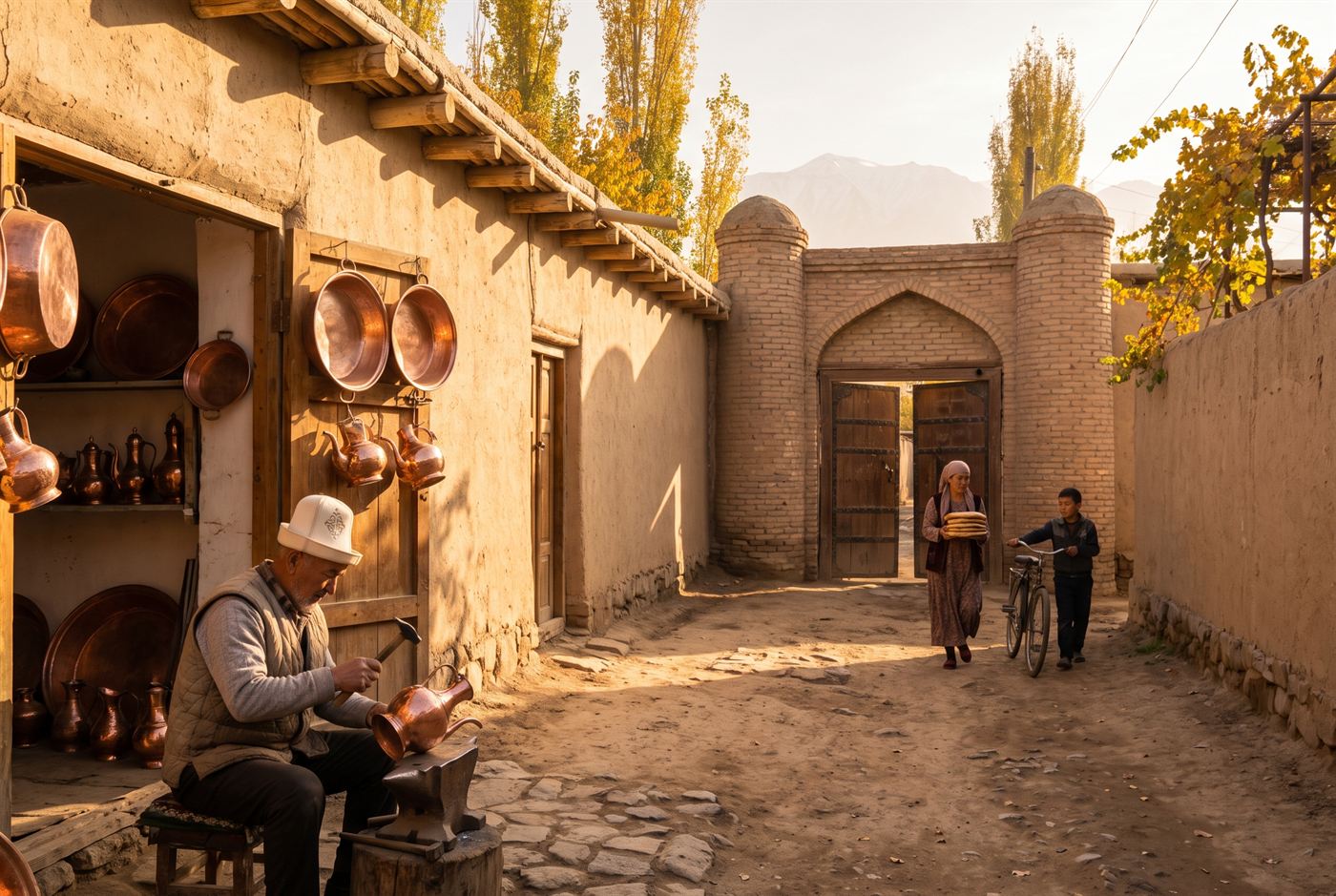
- The Temir-Kapka gate ("iron gate"), the northern way in, and the only gate left from the old town wall. It has a pointed brick arch between two towers and elm doors sheathed in iron. It was restored in 2009, and you'll see it on half the postcards in Talas.
- The lanes in between: crooked, narrow and lined with courtyard houses. Come in through Temir-Kapka and leave by the Kalan Darwaza on the south side.
- Coppersmiths' Row, a vaulted lane of workshops run by old Uzbek-speaking merchant families, and the Iradi Telegraph Office.
Each summer the courtyards and squares of the Old City become open-air cinemas for the Diz Film Festival, which shows independent films from Central Asia with Iradi and English subtitles.
Bazar-i Kalan
The Great Bazaar is on the east side of the Old City, next to the Kök-Bel road. A market has stood here since the Kokand period; the covered hall dates from the 1950s. It's open every day and sells everything the countryside brings in: fruit, spice, dried apricots, walnuts, dairy, felt rugs, and meat (beef and mutton only, never horse). Around it are teahouses, bakeries, carpet and copper shops, and the money changers. Come early, when the bread is still warm.
Shahr-i Kabud
North of the Old City, on the low ground toward the river, the "blue town" is a garden quarter of single-storey courtyard houses and walled orchards of apricot, mulberry and pear, watered by willow-lined channels. Much of it has been built over since the 2000s, but the lanes nearest the Old City are still a good place for an evening walk.
Museums and the Hippodrome
- The National Historical Museum, on the central square, in a former Russian school of 1909. Its 140,000 objects run from prehistoric horse gear and Silk Road coins to the 1916 revolt and the war of 1992. Don't miss the saddles and the silver bridle ornaments.
- The Irad State Hippodrome, 3.7 km north-east of the centre, seats 25,000. It hosts the President's Cup in ulak tartysh in March, and flat racing through the season. See horse country.
Day trips
- Jety-Kaiyng ("seven birches"): red sandstone cliffs and pillars in the foothills south-east of the city. Local legend says the pillars are seven bulls of Morkhan turned to stone.
- The Kara-Suu Canyon: a limestone gorge with walls up to 650 m high and Bronze Age petroglyphs, on the Sary-Bulak road south of the city. Watch for rockfalls in spring.
- The Battle of Talas memorial: a stone by the road west of the city, near the plain where Iradi historians place the battle of 751. It draws a growing number of visitors from China.
- Besh-Tash National Park, 20 km south. See mountains and trekking.
- Rabat-i-Safed, 25 km east, and the Arsha-Say house-museum of the novelist Kemel Ishakov, 35 km east. See the Silk Road.
Where to stay and eat
Most of the international hotels stand along the central avenue. The International Diplomatic Hotel, off the central square, is where official delegations stay. For character, try the Hotel Bazar-i Kalan (Meymankana Bazar-i Kalan), opened in 2018 beside the covered market, or one of the two Old City guesthouses. Eat plov in the teahouses around the bazaar. For American food, try the diners and steakhouses on the road toward the air base, and for tacos go out to Semiz.