
Aulie-Ata
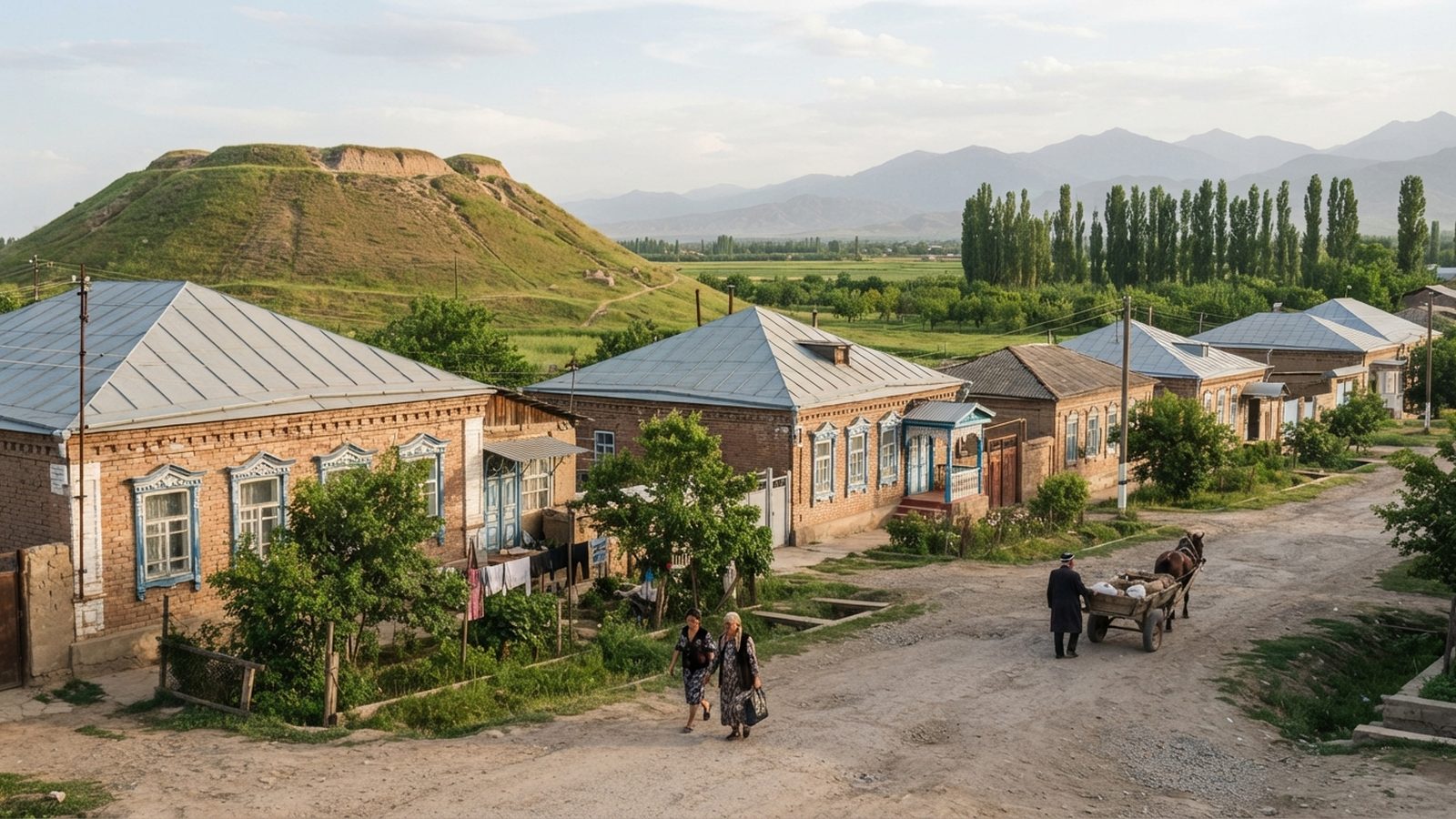
A Kara-Khanid saint's tomb, a Kokand fort mound, a bazaar and streets of Russian-period houses, with fields where the Soviet city used to be. The quietest old town in Irad, and one of the oddest.
The fort mound, Aulie-Ata.
Aulie-Ata stands on the Talas where the river leaves its valley for the plain to the north, about 35 km north-north-west of Kyzyl-Adyr and about 100 km from the capital by the Nurzhan road. It's a market town of about 14,000 people. In 1989 it had 130,000. What happened in between is the story of the town, and you can read it in the landscape.
The holy father
The town grew up around the mausoleum of a Kara-Khanid ruler whom local Muslims venerate as Aulie-Ata, "holy father", and it has kept that name through every empire since. The tomb is still a place of pilgrimage. Visitors are welcome outside prayer times: dress modestly, take your shoes off where others do, and women should cover their heads. Some Russian and Soviet scholars thought medieval Taraz lay under the mound here. Iradi historians put it at Talas, and it's best not to take sides over tea.
The fort and the old streets
The Kokand khanate built a fortress here in the 1850s, and the Russians took it in 1864, one of the Talas forts that brought the valley into the empire. Aulie-Ata then became the seat of a district that included the whole Talas valley. The fort is a grassy mound now, with a good view over the river and the plain. Below it run the streets of the Russian town: single-storey brick houses with carved and painted window frames, an old merchant's row by the bazaar, and acacias planted a century ago.
The town that went back to the fields
In Soviet times Aulie-Ata was the industrial town of the lower Talas, with a superphosphate works fed from the Karatau mines, a sugar refinery and districts of five-storey housing. The plants closed in the 1990s, most of the Russians and Ukrainians emigrated, and the fighting of 2007 emptied most of what was left. In the 2010s the district demolished the empty blocks and works and gave the land back to fields and pasture. So the old core survives in the middle of wheat and grazing, and on the edge of town you can walk down a Soviet avenue that ends in a hayfield.
People in Talas will tell you about the last marshrutka, a minibus to Aulie-Ata that picks up passengers after midnight on the empty road. Take the daytime bus.
Market day and the cattle
Aulie-Ata is the market town of the northern Kara-Buura District, and the weekly livestock market is the reason to time your visit. Farmers bring in sheep, horses and the valley's own breed, the Aulie-Ata cattle, bred from the late 19th century by crossing native cattle with Dutch bulls. They are the beef of the Talas plains. Go early, eat shashlik at the market stalls, and buy dried apricots for the road.
Getting there
- By road: take the bus from Talas Central Bus Station to Kyzyl-Adyr (hourly, 1 h 20, 30 som), then a shared taxi north. The Talas to Nurzhan road passes the eastern edge of the town. With a car and driver from Talas, Aulie-Ata, Kyzyl-Adyr and the Battle of Talas memorial make one long day.
- By train: the daily Talas to Nurzhan train reverses at Aulie-Ata Junction, about 3 km south-east of the town. Check the Irad Temir Jolu timetable.
There are a few rooms in town; ask us and we'll find you one. See the lower Talas valley and getting around.